In 2026, e-commerce will continue to surge as customers will prefer mobile purchasing (mCommerce), quick online shopping with AI suggestions, and also creator-driven online stores for digital products. As we are focusing on small businesses and creators, features like an AI website builder, pre-built templates, and affordable apps/integrations are a must.
An e-commerce website builder is supposed to be simple, easy-to use and always focuses on letting users sell products effortlessly without any technical headache. A right e-commerce website builder must offer intuitive setup, flexible design, built-in marketing tools/templates, and AI features to automate workflows.
If you are a small business owner or creator, finding the best e-commerce website builder must be confusing and complex, as there are hundreds of options available.
To help you choose the best website builder for small business eCommerce, we have evaluated each builder based on ease of use, customization options, scalability, multichannel selling, AI capabilities and pricing transparency.
In this guide, we will break down the 10 best e-commerce website builders for 2026 to help you launch and grow with confidence.
What to Look for in an E-commerce Website Builder in 2026
Choosing the ideal e-commerce builder is now way more than a good-looking website. You must look for a platform that provides quick setup, a vast number of templates/integrations, built-in AI suggestions, and most importantly, multi-channel selling.

#Quick Store Setup
Small business owners require a website builder with zero coding requirements or a minimal learning curve. Look for a builder that offers easy-to-use drag-and-drop features, guided onboarding, and lots of pre-built templates that help launch your e-commerce fast—even without having any technical skills.
How to Launch Your Store Instantly

Modern website builders remove the traditional barriers of website development.
With drag-&-drop builders, pre-built templates, and guided onboarding, small businesses
can launch an online store within a few hours.
#AI-Powered Tools
AI is dominating the world, and so is the e-commerce market. Having AI-facilitated builders helps to automate tasks like writing product descriptions, image automation, SEO optimization, product filtering, product recommendation, AI chatbots, and many more.
How AI is Transforming Online Stores?

AI tools can now help you:
• Generate product descriptions
• Suggest products to customers
• Optimize SEO automatically
• Personalize shopping experiences
#Multi-Channel Selling
Choose a platform that offers multiple channels for global sales. Platforms that have integration with Facebook shops, Amazon, Alibaba, and Instagram are more preferable website builders. It also increases visibility and helps to reach new buyers or customers beyond the website.
#Multiple Payment Options and transaction fee
Multiple payment options offer flexibility to buyers, including credit cards, mobile wallets, and buy-now-pay-later options. A Flexible payment option significantly reduces cart abandonment rate as well as increases trust. Additionally, a transparent transaction fee facilitates the calculation of real profit margins.
##Integrations
A good e-commerce website builder should offer integration with CRM systems, inventory management, shipping tools, and analytics apps. Having these add-ons helps to customize your store, aligning with your needs.
#Mobile Commerce
By 2028, global mobile e-commerce is projected to reach a revenue of approximately $3.35 trillion, and half of e-commerce sales now come from mobile devices. Therefore, your e-commerce store must appear professional and load quickly on mobile devices.
Look for builders that provide high-quality, mobile-responsive templates and a dedicated mobile app for managing orders on the go. A strong mobile presence is necessary for attracting modern shoppers.
Many small businesses fail to scale their online stores because their platform cannot handle growth.
When choosing an e-commerce builder, always check:

• Scalability
• Integrations
• Automation tools
• Pricing transparency
The 10 Best E-Commerce Website Builders for 2026
Before heading to the detailed overview, check out the list of the top 10 best e-commerce Website builders:
EzyStudio- A Hybrid and modern website builder
Wix- Best for huge e-commerce templates
WooCommerce- Flexible e-commerce solution
Zyro- For small shops and single-product businesses
Square Online- An excellent in-person sales platform
Shift4Shop- Best enterprise-level e-commerce tool
Weebly- A beginner-friendly platform
Ecwid- Best for multi-channel selling
Volusion- Best for detailed e-commerce analytics
Squarespace- Best for design flexibility
1. EzyStudio

EzyStudio is a modern, AI-powered agency-focused website builder that offers a specific app builder for e-commerce. Unlike other traditional builders or old drag-and-drop builders, it gives you full control to build AI-powered websites or even e-commerce sites with built-in e-commerce templates.
The key strength of this platform is that it combines fully customizable drag-and-drop fields with a built-in CMS system (a managed content structure). You simply need to drag and place your preferred block or template, then input your content, and instantly preview the dynamic content design in real-time.
Some other key features include built-in SEO tools, creating a branded app with the app builder, creating an e-commerce store with pre-built e-commerce tools, and many more.
EzyStudio solves a common user pain point, which is tons of advanced features at an affordable price! For each pricing plan, users can enjoy lifetime pricing and built-in features rather than paying monthly fees. No headaches for extra apps or third-party plugins. A budget-friendly platform yet powerful choice for long-term growth.
Key Features

#EzyStudio Templates/UI block
EzyStudio provides a ready-made UI section that contains more than 500+ pre-built blocks and 250+ templates that can fit any brand. Both templates and blocks are highly customizable with global style settings for typography, granular control over each section/element, and modifying colours, layouts, and content to resonate with your branding.

On top of that, advanced users can inject custom code (CSS, JavaScript) for specific designs and functionalities. Users can also utilize CMS collections as a data source for creating dynamic layouts, ensuring a visually appealing design.
Every block and templates are designed for designing product pages, catalog layouts and checkout sections
#Integrated CMS
A built-in CMS is a core feature of EzyStudio. With this integrated CMS, users can manage dynamic content effortlessly without worrying about block or template design. Users simply drag and drop content or block templates and manage content dynamically across the entire website. This eliminates the need to manually update content page by page. Any content published and stored in the CMS is automatically updated wherever it appears.
Users can manage product descriptions, categories, blog posts, FAQs, reviews, and other dynamic content from a single, unified dashboard. As a result, there is no need to edit the same product description in multiple places. Once the CMS is updated, the entire store is automatically synced.
Users can also customize the appearance of each element, block, and page template visually within the builder. In addition, they have full control over styling settings for different devices. The builder allows precise control over layout and appearance for desktop, tablet, and mobile views.
Because dynamic page creation is simple and flexible in EzyStudio, it’s pretty much perfect for large product catalogs, collection-based stores, blog-driven SEO websites, and marketplaces. This feature offers a user-friendly interface while supporting complex content structures.
#Real-Time Delivery Tracking System
EzyStudio offers store owners a full transparency built-in delivery status tracking system. They can update each order’s progress with clear headings like- Processing, Shipped, Ready for Pick-Up, Picked Up, and Delivered. This feature helps significantly reduce customer inquiries and improve post-purchase satisfaction for customers.
#Order Management Dashboard
EzyStudio provides a clean and intuitive dashboard for store owners. They can view all their orders and easily manage them. For each order, it shows full pricing details, product breakdowns, customer information, and payment status. Ultimately ensures, owners never miss any important data. They can also filter, sort, update, and manage orders effortlessly.
#Advanced Coupon and Discount System
With EzyStudio, business owners can create coupon codes and discounts in just a few clicks. Under this discount system, owners can set up category-based offers, fixed-amount discounts or a percentage-based discount. Using these features, store owners can run loyalty programs, seasonal sales and bundle offers without any third-party app integration.
#Blogging and SEO Tools
EzyStudio provides a fully integrated blogging system that allows users to maintain a rich blogging section from edit to publish. Also, as we discussed earlier about integrated CMS and CMS collections, managing a dynamic blogging page and blog content is super easy.
This platform also includes features such as multilingual support and reusable components/blocks, white-labeled dashboards, and inherent mobile-friendliness. Hence, creators can effortlessly manage blogs and market their brands.
EzyStudio also includes some out-of-the-box SEO features-
Meta tag controls (Customization of meta titles and descriptions for every page and CMS item)
URL slug management (Clean and readable URLs)
Built-in caching system for faster loading time
#Agency & Multi-Client Support

EzyStudio is also well suited for agencies that build and manage multiple eCommerce stores. It allows agencies to create fully branded, customizable stores from a single dashboard, making client site management more efficient.
Agencies can white-label the platform with their own logo, colors, and domain, so clients access stores through the agency’s branded environment. Built-in billing automation with Stripe and PayPal support also helps agencies handle invoicing and payments without relying on external tools.
With a centralized dashboard to manage client stores, subscriptions, and payments, EzyStudio is a practical choice for agencies scaling multiple eCommerce projects.
#Multi-layer Caching System and Site Performance Metrics
Page loading speed is a crucial aspect for larger e-commerce websites and EzyStudio commits to 20× faster page loading with Smart Multi-Layer Caching. As EzyStudio prioritizes quick and effortless website creation, it also ensures the website remains fast, high-performing, and always accessible.
This platform provides a built-in caching feature, which handles not only static files like images, CSS, JS, but also dynamic content via their in-house CMS collections.

Best Suited For
Creators, freelancers, and small businesses who want a quick store setup without any technical knowledge
Agencies that offer web store building services.
Pros
Under one unified place, you will get everything - website builder, blog, CMS, store, and branded mobile app.
Good value for lifetime deal price.
Cons
White-label branding is available on the higher pricing plan
Being relatively new, it may have a small support community.
Pricing and Plans

Each plan offers a lifetime deal.
Basic- $199/lifetime
Pro- $449/lifetime
Elite- $1549/lifetime
Agency- $3190/lifetime
👉Get EzyStudio Lifetime Deal Now!
2. Wix

Wix e-commerce is popular for its fully customizable website templates. It offers more than 900 free e-commerce templates that are specially designed for mobile devices. Also, its impressive design flexibility and beginner-friendly interface make it a perfect fit for small to medium online stores.
Moreover, Wix offers AI builder, which allows users to create a functional website by asking a few questions about the store's goals and needs. Users can change site theme, shuffle layouts, and update site content simply by giving a few commands to the AI builder.
Regardless of these builder features, Wix E-commerce offers some key features of e-commerce - inventory management, tracking product stock, managing product options, payment handling, shipping/tax settings, and product marketing tools. Wix store supports selling both digital and physical products.
Key Features
Its AI-enabled drag-and-drop store builder allows 900+ customizable mobile-responsive templates.
Wix store module for product catalog, managing products, inventory management and stock alerts.
Global text payment settings.
Multiple payment gateways- Wix Payments, PayPal, Stripe and some regional options.
Integrated shipping settings- shipping labels, real-time shipping rate and local pickup option.
Omnichannel retail to sell anywhere- Amazon, eBay, Facebook, and Instagram.
The Wix app market has 300+ integrations for inventory tools, dropshipping, loyalty programs, analytics, analytics and reviews.
Best Suited For
Suitable for freelancers, agencies and enterprises. Although steep learning curve for enterprise-level features.
Wix Studio for organizations and software providers.
Pros
The user will get ultimate design freedom.
AI-powered website builder
Built-in e-commerce basics
Supports physical, digital, and service-based products
Cons
After store launch, shifting design or templates can be difficult.
Scaling options are limited compared to other big e-commerce names.
Pricing and Plans
Offers a free plan
Four pricing plans with ecommerce-ready features, starting from $17/month
Comparison: EzyStudio vs Wix

3. Weebly

Weebly’s e-commerce module is ideal for individuals as it provides a beginner-friendly user interface compared to other builders. It’s more like a traditional, drag-and-drop website builder, which offers ease of use but has restrictions on advanced builder editing, templates, blocks, and SEO features. No doubt, Weebly is the best e-commerce website builder for small businesses because of its flexibility and affordability.
This e-commerce builder provides an integrated shopping cart and secure checkout system directly from the e-commerce website. Also, whenever a user creates an online store, a shopping cart will be automatically set up without requiring any technical skills. Users can easily track their inventory, and customers will be notified if any items are sold or restocked. Moreover, users can sell digital and physical products with a powerful filtered product search.
Key Features
Weebly offers 50+ professional templates and themes. For customization, the user will get a different font, header, colour scheme, and access to major web design elements.
Built-in shopping cart & secured checkout system.
Inventory management with inventory tracking and stock alerts.
Free e-commerce hosting
Users can import their external online product to the Weebly store
Sellers can control shipping rates based on weight, price, or location, tax calculations, manage bulk orders, send confirmation emails, track shipments, and manage refunds or returns.
Best Suited For
Suitable for individuals, small businesses, and entrepreneurs who want to quickly launch store without any heavy investment and advanced technical skills.
Wix Stusio for organizations and software providers.
Pros
Easy to use and affordable
Support the selling of various products
Basic but necessary e-commerce essentials are available
Supports physical, digital, and service-based products
Cons
Design flexibility and customizations are limited.
Not ideal for a complex store
Pricing and Plans
Offers a free plan
The other four plans start from only $10/month!
4. WooCommerce

WooCommerce is a full-fledged, versatile WordPress e-commerce solution without any doubt.
With a wide range of extensions, plugins, and marketing tools, this platform offers endless customization. For each e-commerce solution- automation, payment, shipping, and taxes analytics can be extended with over 800+ e-commerce-specific extensions.
Key Features
The user can create an SEO-friendly structure using popular plugins like Yoast or RankMath.
Supports physical, digital, and subscription-based products.
Detailed reporting for inventory and order management.
Product pages are highly customizable with plugins like Elementor.
Best Suited For
Businesses that already use a WordPress website
Creators who need plugin flexibility.
Pros
It’s free, so it’s a budget-friendly setup
Great for SEO focused sites
User will get a great support team and a dedicated community. Also, the developer and plugin ecosystem is huge.
Supports physical, digital, and service-based products
Cons
No dedicated hosting or security feature.
For an advanced feature, users need a paid extension and a complex setup
Pricing and Plans
The WooCommerce plugin is free.
Comparison: EzyStudio vs WooCommerce

5. Square Online

Square Online can be an excellent choice for those who want to merge their e-commerce business with online and on-premise sales. This seamless integration between online sales and in-person sales makes order tracking, inventory management, and payment processing more effortless.
Square Online is one of the most convenient choices for food businesses and retailers to transition from a physical storefront to online selling. With its strong POS (Point-of-Sales) integration, fast checkout options, and multi-location management, it becomes quick.
Other than inventory tracking and in-person sales, this platform has a central directory where sellers get to view a closer look at their customers ’ recent purchases, sales history, and loyalty points.
Key Features
Square Online’s native integration of the POS system helps sellers to handle payment, track inventory, and manage data easily.
It provides a code-free store setup.
30+ professional themes.
Multi-fulfillment options like shipping, curbside pickup, and local delivery.
Scheduling sales is available to create sales hype.
Automatic inventory syncing after the store setup
Integration with Instagram, Facebook, and Google product listings.
Best Suited For
Suitable for local businesses, retail shops, cafes, and restaurants
Multi-location businesses that need a consistent inventory sync.
Pros
Best POS–ecommerce integrations
Free plan with core features.
Ideal for local selling and in-store pickup options.
Cons
Website builder’s customisation is limited.
Not ideal for large stores or advanced e-commerce scaling.
Marketing tools are limited compared to other platforms.
Pricing and Plans
A free plan is available
Offers two other plans starting from $49/month/per location.
It also offers custom pricing.
6. Shift4Shop

Shift4Shop is cloud based e-commerce solution formally known as 3dcart. It is a one-stop solution for your e-commerce solution. From free domain registration to built-in fraud detection, you will get every e-commerce function under one unified place.
Some core e-commerce solutions this platform offers are- unlimited product variations, catalog management, single page checkout, CRM and PSI-certified checkout. Also, it provides a variety of marketing tools like built-in SEO tools to abandoned cart saver, you will get basic to advanced level features. It also supports multichannel sales as it has integration with eBay, Facebook, Amazon, and Aliexpress.
Key Features
100+ pre-built professional templates, which are also customizable.
Unlimited products, detailed inventory tracking, SKU/product tags, cloning, filtering, and order processing
For retail and B2B businesses, there are real-time shipping rate calculations, shipping labels, shipment tracking, and support for carriers like UPS, FedEx, and USPS.
Free SSL certificate, PCI-certified checkout system.
Product comparison tools up to 4 products.
Best Suited For
Suitable for Merchants who offer shipping to multiple regions, large product catalogs and most necessarily need flexible payment or shipping options
Pros
Variety of mobile-friendly themes and templates
Built-in fraud detection
Wide range of marketing and conversion tools.
Cons
Users can use the free plan only if they opt for Shift4’s payment gateway
Less functional than the other simple drag-and-drop builders.
Pricing and Plans
A free plan is available with its integrated payment gateway
Enterprise-grade plan for $41/month.
7. Squarespace

Squarespace is designed to cater specifically to small businesses and creative individuals. This platform provides some amazing and aesthetic design tools for online stores, which ensure advanced design flexibility. Customization is available to match users’ brand identity.
Though it’s not an e-commerce-focused platform, it has good e-commerce features like secure checkout, inventory tracking, product variations, shipping integrations, and built-in marketing tools. Squarespace AI helps to make product descriptions, page copy so that getting online doesn’t take time.
Key Features
It offers sleek and minimalist design templates for brand storytelling and product display.
Squarespace’s blueprint AI is an enhanced AI website builder that effortlessly helps sellers to create a unique yet professional website.
45+ templates with easy-to-customization option.
Real-time shipping tools with USPS, FedEx, and UPS integrations.
Built-in email campaigns, social media posting, and powerful scheduling apps.
Inventory management with the inventory API feature to sync with other e-commerce platforms on Squarespace/
Best Suited For
Suitable for small creators, artists, and boutiques that prioritize a design-first store.
Users who want aesthetic templates with a straightforward e-commerce tool.
Pros
Provide a richer template library than other platforms.
Clean drag-and-drop editor
Strong social media integration
Cons
Less scalable for a complex e-commerce store
Requires some advanced-level design knowledge
Basic e-commerce feature compared to other platforms.
Builder’s customization is also limited.
Pricing and Plans
It offers two e-commerce-focused plans starting from $28/month
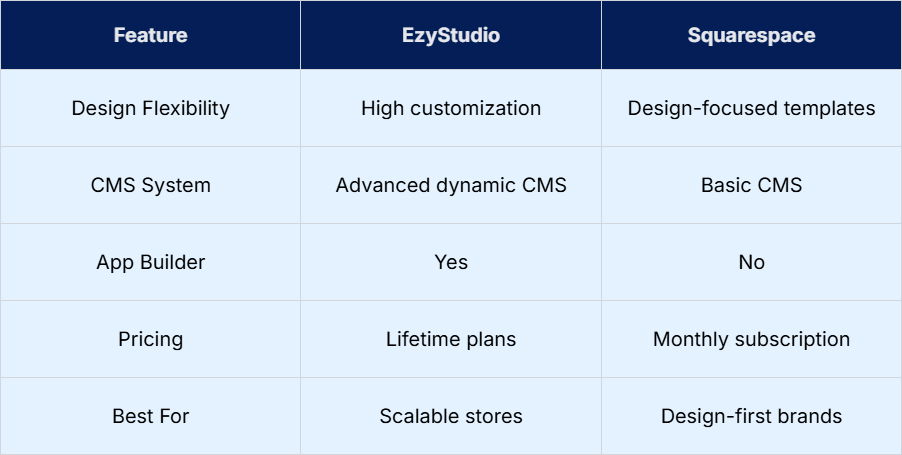
Comparison: EzyStudio vs Squarespace
8. Volusion

Volusion also provides a beginner-friendly e-commerce tool for small to medium-sized businesses. It offers comprehensive tools for analytics, which help to take a data-driven solution easily.
It offers product management, order processing, and detailed analytics for e-commerce features. The platform also provides a scalable product catalog engine. It supports large SKU volumes, variant combinations, and advanced product option controls. This platform is PCI-certified and offers secure checkout hosting without needing third-party tools.
Key Features
Mobile responsive and customizable layouts.
Under inventory and stock management, sellers can manage warehouse, track stock levels and handle product variants.
Provide PCI-certified checkout with multiple payment gateways.
Built-in SEO tool offers clean URLs, meta tags, 301 redirects, sitemap generation for higher visibility.
Best Suited For
Suitable for Small and medium-sized online stores that require moderate product catalogs. Users who want aesthetic templates with a straightforward e-commerce tool.
Pros
Secure and reliable checkout process.
Detailed sales analytics
Doesn’t charge any extra transaction fee.
Cons
Basic template library
No scope for selling digital products
Lacks of built-in blogging and content features
Builder’s customization is also limited.
Pricing and Plans
Custom pricing is available.
It offers four plan starting from $35/month.
9. Ecwid

Ecwid is the best website builder for small business who wants to expand their business beyond a single website. Its shopping cart can be integrated into both websites and social media channels. The key point to choose Ecwid is its ability to excel in multichannel selling and control literally everything like centralized inventory, order management from a single platform.
Unlike other traditional website builders, it functions as an embeddable storefront. It can be installed on WordPress, Wix, Weebly, custom HTML sites using a few lines of embed code.
Its inventory management module has tracking inventory, restock alerts, setting custom out-of-stock behaviour, manage inventory with Google Sheet. Its mobile app allows merchants to manage orders, scan items with the camera for stock updates, discounts, and communicate with customers—all in real time.
Key Features
This platform allows for managing orders from all sales channels on one platform with payment and fulfillment status.
It offers global shipping through popular carriers like FedEx, UPS, Royal Mail, and more. Also, there are flexible local delivery options depending on thezones, and sellers can offer in-store pickup.
Provide in-depth sales history and insights into all the orders.
It offers a diverse range of payment option; 70+ payment providers to reduce the rate of abandoned cart.
For each order, the tax rate will be added automatically which minimizes the risk of tax calculation error. Also, customers will get an automatic tax invoice upon order on Ecwid.
This platform offers various custom fields to make the checkout page more functional. Also, the checkout system is more secure as this platform is PCI-DSS Level 1 compliant.
Best Suited For
Suitable for Retailers who want online and POS sync.
Sellers who want a quick store setup without any migration problems.
Pros
A great channel for multi-channel sellers.
Support the mobile POS system.
A wide range of multichannel integration.
Cons
Design customization is limited.
Lacks of built-in blogging and content features
Pricing and Plans
Provide a free plan.
It offers four plans, starting from $5/month only.
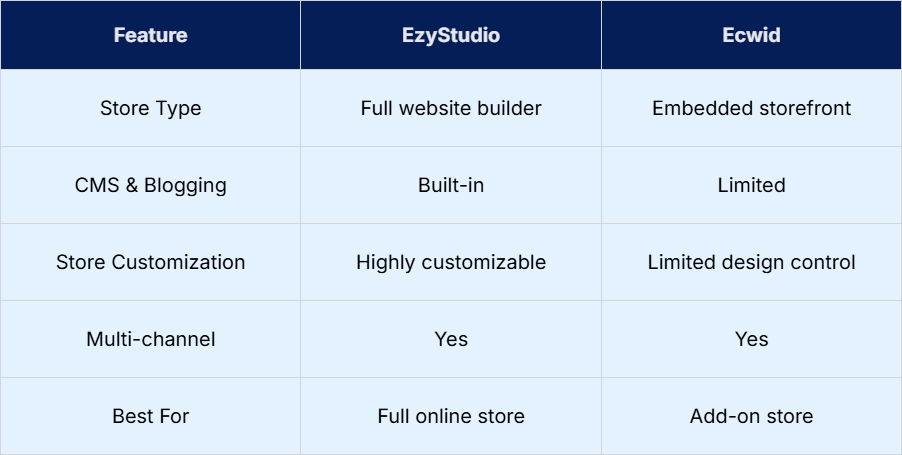
Comparison: EzyStudio vs Ecwid
10. Zyro (Currently Hostinger)
.png)
Zyro is a lightweight, affordable website builder for small businesses. As Zyro has been acquired by Hostinger, it offers an array of e-commerce features and tools. This platform is an easy-to-use to use website builder. Whenever a user edits the website with the drag-and-drop builder, a grid format will appear for guidance.
For e-commerce users, this platform offers simplified product management, AI-powered product descriptions, secure checkout, automated tax calculation, and seamless integration with payment gateways like Stripe and PayPal. To make a strong online presence, Zyro offers an AI-enabled SEO assistant.
Key Features
Ready-made 100+ online store templates.
Offers multiple payment gateways.
Users can integrate the Zyro store with major platforms like Amazon, Facebook, and Instagram to expand their reach.
CRM like features for handling customer interaction.
Users can sell both digital and physical products with other options like gift cards and print-on-demand.
Best Suited For
Small shops, single-product businesses a low-maintenance shop.
Creators who sell digital downloads or small catalogs.
Pros
Affordable pricing
An AI-enabled website builder with such a low cost
Extremely beginner-friendly interface
Cons
Not suitable for a complex e-commerce store
Basic product and inventory management tools.
Limited app ecosystem
Pricing and Plans
E-commerce plan starts from only $2.75/ month, and the first three months are free of cost.

Choose The Perfect E-commerce Website Builder for Small Business
We have discussed some of the popular e-commerce website builders for small businesses, expanding their core features, pros, cons, and pricing plans. Now it's time for you to make a decision.
Some platforms heavily focus on design, some provide a pool of strong integrations and a template library, while others are built for complex stores like Weebly or WooCommerce. But if you’re running a small business and want a tool that feels modern, flexible, and genuinely built for fast growth, the choice should be EzyStudio.
EzyStudio is an agency-focused builder platform, also suitable for single creators or freelancers. As we discussed, some key features of EzyStudio, so we don't want to bore you again by repeating this. Rather than focus on the fact that it is not only a modern website builder, but also provides a business ecosystem under one roof.
Hence, if you are searching for a scalable solution for your e-commerce business, EzyStudio is a clear winner in terms of features, technical capabilities, and long-term product value. This platform combines ease, speed, and advanced tech in one place. Hence, EzyStudio becomes the ideal choice for small business owners in 2026.
